










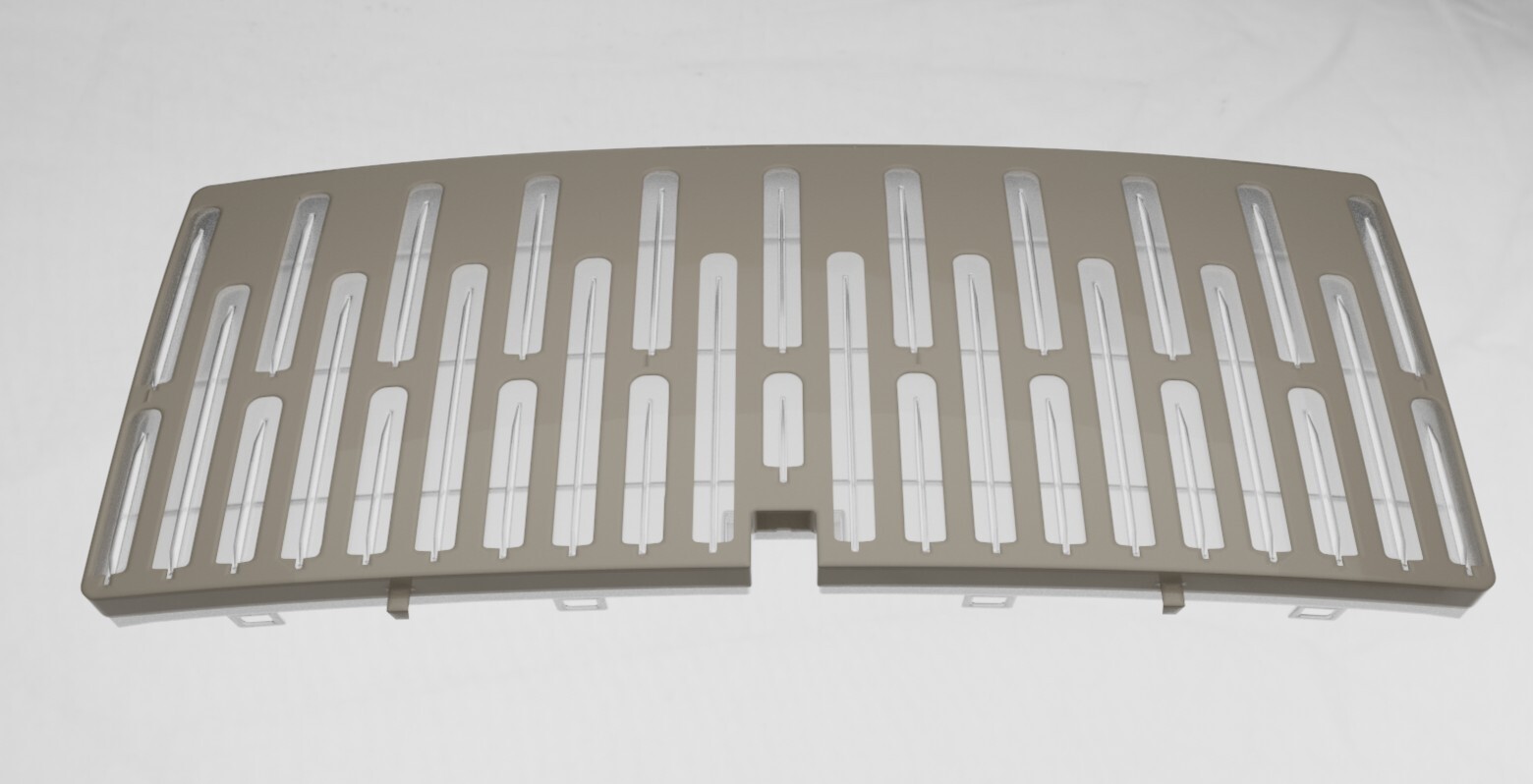
Large-format, light-emitting plastic components are opening new possibilities in automotive design while placing high demands on mold and hot runner technology. Using the example of an illuminated front grille for a premium EV SUV, Synventive, a SPECTRIX brand, demonstrates how complex direct gating, demanding part geometries, and the highest standards of optical quality can be successfully combined. The original component will be on display at the SPECTRIX booth at Fakuma, where visitors can also learn more about the technical features of the application and the hot runner solution used.
Light is increasingly becoming a design element in modern vehicle design. Lighting concepts are no longer limited to conventional headlights and taillights. Large-format body and interior design elements are also being integrated into vehicle lighting concepts. This creates new challenges for injection molding: Complex geometries must be filled reliably, transparent polymers must be processed gently, and at the same time, the highest standards for visible surfaces must be met.
One example is a large-format, light-emitting front grille for an EV SUV. The 2K component is manufactured from transparent polycarbonate (PC) and black ABS on a KraussMaffei injection molding machine featuring SpinForm technology. For this application, Synventive developed a hot runner solution specifically tailored to the component geometry and its optical requirements.
SpinForm for Large-Format 2K Components
SpinForm technology is based on a swivel-platen concept with two parting lines. This allows two molds to be arranged, one behind the other and both components to be injected simultaneously. The process is particularly suitable for large-format multi-component parts and, compared with rotary-table technology, enables twice the output with the same clamping force.
For the light-emitting front grille, the technology thus provides the machine-side basis for the cost-effective production of the large-format 2K component made from transparent PC and black ABS.
Filling Behavior Optimized from the Design Stage
One of the key challenges is achieving controlled filling of the complex geometry. Particularly in transparent areas, unfavorable melt-front behavior and weld lines can adversely affect the final optical appearance and performance of the component.
For this reason, the filling behavior was analyzed and optimized using Moldflow simulations during the hot runner system design phase. Simulation makes it possible to evaluate the interaction between part geometry, gate positions, and flow paths at an early stage.
The objective was to achieve the most balanced possible filling of the component while precisely controlling the melting fronts. This made it possible to move weld lines away from optically critical areas and reduce potential impairments to visible and light-transmitting surfaces.
The thin wall demanded a high number of gating points to reduce flow lengths and therefore the design and perfect manufacture of the hotrunner flow bore geometry was critical to achieve the filling balance dictated by the moldflow studies.
Multi-Zone Heating for Extra-Long Nozzles
Another technical challenge results from the need to reverse gate and the considerable installation depth of the application. The hot runner solution uses extra-long nozzles, making particularly precise thermal management essential.
For this purpose, Synventive uses multi-zone heating along the nozzles. This allows the temperature profile to be precisely controlled and kept stable over the entire nozzle length. This is particularly important when processing transparent polycarbonate: Excessive or uneven thermal exposure can cause material degradation and yellowing, directly affecting the optical quality of the component.
Controlled temperature management supports gentle processing of the material while providing the conditions required for a stable injection molding process.
Direct Gating for Demanding Surface Requirements
In addition to material quality, the positioning of the gates plays a decisive role. For a large-format visible component, filling and process requirements must be reconciled with the design specifications for the Class-A surface.
The application therefore uses direct reverse gating. This keeps the high-quality visible surface free from visible gate marks. At the same time, precise valve gate technology ensures correct gate opening timing and surface cosmetics.
The combination of simulation-based system design, controlled temperature management, and precise direct reverse gating enables contamination-free processing of the transparent PC with high optical quality and light transmission.
See the Part and Explanation at the SPECTRIX Booth at Fakuma – Hall A1, Booth 1208
SPECTRIX brings together the brands Männer, Foboha, Synventive, Thermoplay, Gammaflux, and Priamus and provides end-to-end solutions for demanding injection molding applications.
Figures: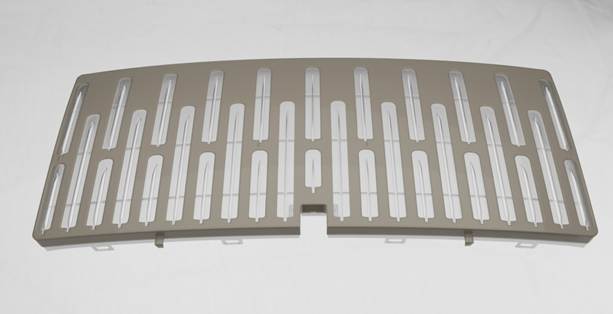
Fig. 1: 2-component front grille
About SPECTRIX
SPECTRIX brings together the industry-leading brands Männer, Foboha, Synventive, Thermoplay, Gammaflux, and Priamus. Combining more than 50 years of expertise with 2,000 specialists worldwide, SPECTRIX delivers the full spectrum of end-to-end injection molding solutions.
From part design and material science to molds, hot runners, sensing and control technologies, qualification, specialty molding, and lifecycle services, SPECTRIX supports every stage of the injection molding process. Customers can choose individual technologies and services or benefit from a fully integrated end-to-end solution tailored to their specific needs. With a global footprint and strong local expertise, SPECTRIX partners with customers from concept through series production.
SPECTRIX – Enduring Advantage, Engineered.
Contact
Europe:
Lena Haack
Americas:
Brady Richman