










Interest in thermoplastic and LSR combinations is growing because they bring rigid structures and flexible functions together in one component. However, production has traditionally relied on two methods: combining both processes in one machine or separating them across two machines. Both methods work, but each requires a compromise.
The Foboha LSR Cube introduces a third method. By separating the process steps into dedicated working positions within one integrated system, Cube can improve productivity and make LSR practical in applications where manufacturers previously selected TPE or relied on separately molded LSR components and subsequent assembly.
Thermoplastics provide rigid geometry, structural support and dimensional stability. LSR adds flexible functions such as seals, membranes and soft-touch surfaces, together with long-term elasticity and resistance to temperature, chemicals and aging. Combining them can create product functions that neither material can deliver alone.
Overmolding can also replace separately molded components and subsequent assembly. This reduces handling, intermediate inventory and potential leak paths, while providing a more direct route from molding to a finished functional part.
Thermoplastic melt is injected into a cooled cavity, where the part solidifies. LSR is delivered through a cooled feed system into a heated cavity, where it cures. Combining these opposing thermal conditions within one production concept—without one process limiting the other—is the central challenge of thermoplastic–LSR overmolding.
The two established production methods
The first method integrates thermoplastic molding and LSR overmolding within one machine, using either rotary/index transfer or robotic in-machine transfer. Both configurations avoid inter-machine transfer, but the two processes share the machine layout and overall production cycle. Their opposing thermal requirements must be managed within the same system, and the total cycle is influenced by the slower process. As cavitation and mold size increase, thermal management, transfer and mold integration become more difficult to optimize.
The second method separates thermoplastic molding and LSR overmolding across two machines. Each process can operate in its own thermal environment and be optimized independently. However, the thermoplastic substrates must be removed, transferred, oriented and loaded into the second mold. At higher cavity counts, this requires more complex automation and precise positioning, while increasing handling time, floor space and the number of equipment interfaces.
The conventional choice has therefore been to keep the part within one machine and accept shared process constraints, or to separate the processes and accept external transfer. These two routes are often treated as the only available options. The Foboha LSR Cube introduces a third.
LSR Cube introduces a third manufacturing method
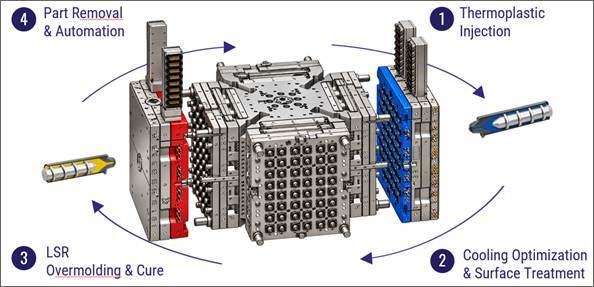
LSR Cube uses a rotating central section to carry the thermoplastic substrate from the thermoplastic molding station to the LSR overmolding station. Depending on the application, the Cube can rotate 90 or 180 degrees. Additional working positions can be used for cooling, surface treatment, inspection or part removal while molding continues at the other positions.
In a conventional single-machine configuration, the heated LSR cavities may be positioned directly above the cooled thermoplastic cavities. Their close proximity makes thermal separation difficult. In the Cube configuration, the thermoplastic and LSR cavities are located on opposite machine platens and separated by the central cube. This physical separation allows the two processes to operate in largely independent thermal environments. Cube therefore combines the thermal separation normally achieved with two machines with controlled transfer inside one integrated production cell.
Cube can expand where LSR is used
Cube’s value is not limited to improving how existing thermoplastic–LSR products are manufactured. It can also influence whether LSR is selected at all. In some applications, LSR would provide better temperature resistance, lower compression set, chemical resistance, biocompatibility or long-term performance, but TPE is selected because it is easier to integrate into the molding process. The material decision is therefore driven by manufacturing constraints rather than product performance.
In other applications, LSR is selected for its performance, but the silicone component is molded separately and assembled later. This avoids the difficulties of integrated overmolding but adds another molding process, handling, inspection, inventory and assembly.
LSR Cube offers another route: LSR can be selected for its performance and overmolded within one coordinated production process. This can support conversion from TPE, replace separate LSR molding and assembly, and enable new product concepts that were previously too difficult to industrialize. Cube can therefore improve existing two-component production and expand the range of applications in which LSR is practical.
Cube performance depends on mold engineering
Cube provides an effective architecture for integrating the two processes, but production performance still depends on several critical systems. The thermoplastic hot runner must fill the cavities uniformly, while the LSR cold deck must deliver the material without premature curing and interface precisely with the heated mold. The rotating center section must position the substrate repeatedly and accommodate the cooling, heating, sensing and ejection functions required by the application.
Sealing is particularly demanding. Low-viscosity LSR can enter extremely small gaps. The mold must seal around the thermoplastic substrate without damaging or deforming it, while providing effective venting and controlling the parting-line conditions needed to prevent flash. Precision steel fitting and repeatable substrate positioning are therefore central to the mold concept.
Material selection and part design must also support the process. Adhesion can depend on the selected grades, surface condition, substrate temperature, contamination control and the time between molding stages. Gating, sealing surfaces, permissible flash, substrate retention and thermal exposure should therefore be evaluated before the part and production concept are fixed.
Why SPECTRIX
An LSR Cube project is not simply a mold project. The mold, hot runner, cold deck, dosing system, machine, automation and molding process must function as one production system. SPECTRIX acts as the lead system integrator, coordinating these elements from the initial concept through proofing and validation.
Within SPECTRIX, Foboha brings 30 years of Cube technology experience, including Cube architecture, multi-component mold engineering and the precision tooling required for accurate substrate transfer and flash control. Männer adds thermoplastic hot-runner expertise. ELMET, an LSR industry leader with 30 years of experience, provides dosing and cold-deck technology. ARBURG contributes decades of experience in LSR molding machines and Cube applications and provides the injection molding machine. SPECTRIX leads the integration of these technologies with automation, cavity sensing and process control into one coordinated manufacturing cell.
The complete cell can be assembled, commissioned and tested under production conditions before delivery. In-house proofing goes beyond confirming that the mold produces a part. The thermoplastic and LSR processes are balanced, substrate transfer and automation are tested, and the system is optimized. Advanced metrology, production trials and validation then confirm that the equipment and process can meet the requirements of the finished component.
For the customer, this means fewer technical interfaces, faster industrialization and lower validation risk. Instead of coordinating the mold, machine, dosing, automation and process suppliers independently, the customer has SPECTRIX as the lead engineering partner responsible for bringing the complete production system together.
From product opportunity to validated production
Thermoplastic and LSR combinations can create better products, but the manufacturing method determines whether those possibilities can reach reliable production. LSR Cube provides a third route: largely independent thermal environments, controlled transfer within the mold system and parallel operations inside one integrated cell.
With SPECTRIX as the lead integrator, the Cube mold, hot runner, cold deck, dosing system, machine, automation and molding process can be developed and proven as one production system. This can improve existing two-component production and make LSR practical in products where manufacturing constraints previously led to TPE, secondary assembly or no viable industrial solution.
SPECTRIX therefore offers more than a third manufacturing method - it makes LSR practical for more products.
Foboha is part of SPECTRIX, a provider of end-to-end injection molding solutions. The LSR solution will be on display at Fakuma 2026 at the SPECTRIX booth in Hall A1, Booth 1208.
Figures/Tables: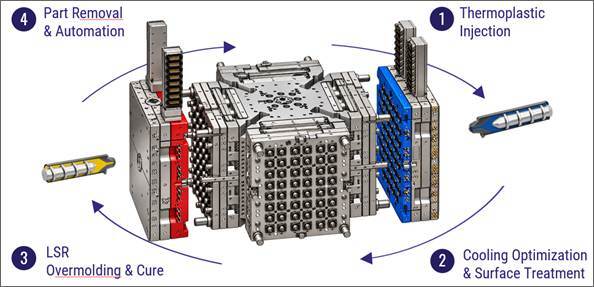
Fig. 1 Foboha LSR Cube. The rotating central section transfers the thermoplastic substrate between the thermoplastic and LSR molding stations while keeping it within the mold system.
|
Criterion |
Conventional single-machine method |
Two-machine method |
LSR Cube |
|
Thermal separation |
Heated LSR and cooled thermoplastic cavities remain in close proximity |
Processes operate in separate machines |
Thermoplastic and LSR cavities are positioned on opposite platens and separated by the central Cube |
|
Substrate transfer |
Rotary/index transfer or robotic transfer within the machine |
Robotic transfer between machines |
Substrate remains on the rotating Cube core |
|
Part positioning |
Mold-controlled or robot-positioned, depending on the configuration |
Dependent on transfer automation |
Maintained on the mold core throughout the process |
|
Cycle organization |
Both processes share one machine cycle |
Independent molding cycles connected by transfer |
Multiple operations run in parallel within one machine cycle |
|
Scaling to higher cavitation |
Increasing mold size, rotating mass or robotic handling complexity |
More parts must be transferred and positioned |
Internal transfer and stationary cavity sections support higher cavitation |
|
Production footprint |
One machine with integrated transfer equipment |
Two machines plus transfer automation |
One integrated production cell |
Table 1 . Comparison of conventional single-machine, two-machine and LSR Cube methods for thermoplastic–LSR overmolding.
About SPECTRIX
SPECTRIX brings together the industry-leading brands Männer, Foboha, Synventive, Thermoplay, Gammaflux, and Priamus. Combining more than 50 years of expertise with 2,000 specialists worldwide, SPECTRIX delivers the full spectrum of end-to-end injection molding solutions.
From part design and material science to molds, hot runners, sensing and control technologies, qualification, specialty molding, and lifecycle services, SPECTRIX supports every stage of the injection molding process. Customers can choose individual technologies and services or benefit from a fully integrated end-to-end solution tailored to their specific needs. With a global footprint and strong local expertise, SPECTRIX partners with customers from concept through series production.
SPECTRIX – Enduring Advantage, Engineered.
Contact
Europe:
Lena Haack
Americas:
Brady Richman